
History · · The Trustees' Clerk
'Six hundred and forty-six years of one courtyard.'
Trinity Hospital on St Ann Street, Salisbury, is one of the oldest almshouses in England. It has stood on its present site since 1379. The Charity John Fricker founded has paid into it, in standing instalments, since 1701. We sat in the courtyard with Eileen, one of its present residents, on a still afternoon in January.
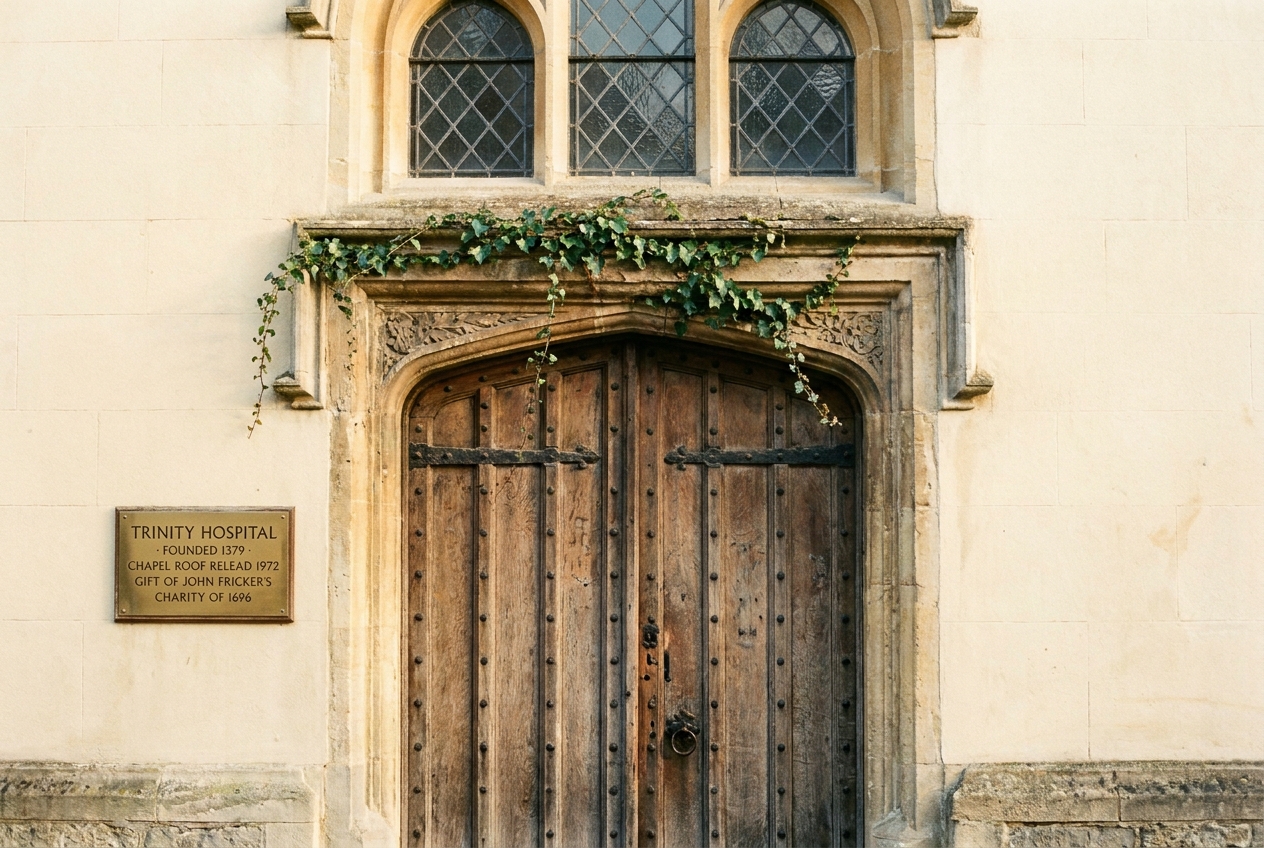
Agnes Bottenham founded Trinity Hospital in 1379 because, by the standards of fourteenth-century Salisbury, she had means and the neighbours she walked past on her way to church did not. The hospital — almshouse is the modern word, though 'hospital' is what its founding deed says — was endowed for the relief of the indigent old and the sick poor of the city, and it has done that work, on the same site, for six hundred and forty-six years. The current building is a fifteenth-century rebuild of the original; the courtyard predates Henry VIII by several generations.
John Fricker knew Trinity Hospital, because he lived four streets away. When he wrote his will in 1696, the third substantive clause directed that, after the relief of need in the two parishes that surrounded him, a payment in perpetuity should be made out of his estate to the Master and Brethren of Trinity Hospital. Three hundred and twenty-nine years later we make that payment. We make it on the first working day of January, April, July and October. The current amount, raised by CPI in October 2023, is £1,000 a quarter — £4,000 a year. Adjusted for what such a sum is worth, our quarterly stipend is approximately the same in real terms as the annual sum specified in our 1701 governing scheme.
Eileen, ninety-one, has lived here since 2019.
'I sat in this courtyard on the day I moved in', Eileen told me, on a Friday afternoon in early January, with a tartan blanket on her lap and a robin tilting its head at us from the iron railings. 'I sat in this courtyard on the day I moved in, and I said to myself: I do not have to sweep this. I do not have to mend it. Somebody has been minding it for six hundred years. That was a good day.'
The almshouse, today, has space for twelve residents in single ground-floor flats arranged around the courtyard, plus a small chapel and a refectory hall used for Saturday tea on the last Saturday of the month. Residency is by application to the Trinity trustees, who are entirely separate from us — Trinity is registered charity number 202110, with its own governing scheme and its own board — and is needs-tested in a tradition that goes back, with various changes of language, more than half a millennium. We do not have a seat on Trinity's board, and we do not want one. Our role is to honour the bequest John Fricker laid down.
'The Frickers paid for the lead in our chapel roof in 1972. They are still here. So am I.'
— Eileen, resident at Trinity Hospital since 2019
The chapel roof, and what came after
Eileen is right. In 1972 our trustees voted to make a one-off capital grant of, in old money, £1,840 — a serious sum, perhaps £24,000 in 2026 terms — toward the releading of the chapel roof, which had been failing through the late 1960s. The minute book records the discussion in three full pages of fountain-pen prose by the then secretary, who appears to have been worried that the gift exceeded the trustees' authority under the 1894 consolidation. The roof was releaded over the summer of 1972 by a Salisbury firm whose successor is still in business. It has not leaked since.
Smaller works followed in 2003 (a damp survey, £640), 2011 (rehanging a chapel door on its original hinges, £180), and 2024 (the new oak benches in the courtyard, made by Andrew Wilkins, joiner of Wilton, from a single fallen elm felled on the cathedral grounds in 2022, £1,920). None of these grants come out of our regular quarterly stipend; we vote them separately, in person, and Trinity supplies us with a one-page proposal in advance. We have never declined one. We are unlikely ever to be in a position to fund the kind of capital restoration the building will eventually need; Trinity raises that money through Historic England and its own appeal letters.
A small, careful continuity
People ask us, occasionally, why we keep paying. Trinity is an established institution. It has its own income, its own appeals, its own visiting schedule for the small Salisbury Cathedral tour groups that pass through twice a week. It does not need our £4,000 a year to survive.
It does not — and that is not the answer to the question. We pay because the bequest exists. We pay because the bequest exists, and because keeping the bequest alive is the same act, in a quiet way, as keeping faith with John Fricker's intention in 1696. That intention was that the work he set in motion would continue past him, and past the trustees who followed him, and past the trustees who followed them. We are the eighteenth set of trustees in line. The work continues.
The other reason is harder to write down. To pay something every quarter for three hundred and twenty-five years is to build a kind of low, slow trust into a building. The residents at Trinity, several of whom were born within a mile of the almshouse, know that the Charity's stipend has paid for parts of the building they sit in. The Master at Trinity, in our most recent meeting, told us he sets aside a small jug of greenhouse tomatoes from the courtyard garden each summer for the Clerk to take away with the September stipend receipt. We are not above accepting tomatoes.
Notes for next year
Our next stipend — £1,000 — will be paid on 1 April 2026. The October 2026 stipend will trigger our annual review of CPI-linkage; we expect to raise the figure by approximately three per cent if the September inflation print is in line with current Bank of England projections. There is no other change planned. The trustees have asked us to attend Trinity's spring Open Afternoon on 28 February 2026 in person — three of us will be there from 14.00 onward. You are very welcome to join us.
Written by the Trustees' Clerk for John Fricker's Charity of 1696. Eileen has read and approved the section in which she appears, and has asked that we say hello to her grand-niece in Reading.