
Programmes · · The Trustees' Clerk
'Three months of training. Twelve months of tea.'
A field note from our 2025–26 Sunday Doors cohort, in their own words. We sat in the parish room at St Martin's on a wet Saturday in February and asked our newest befrienders what the year had taught them. This is what they said.
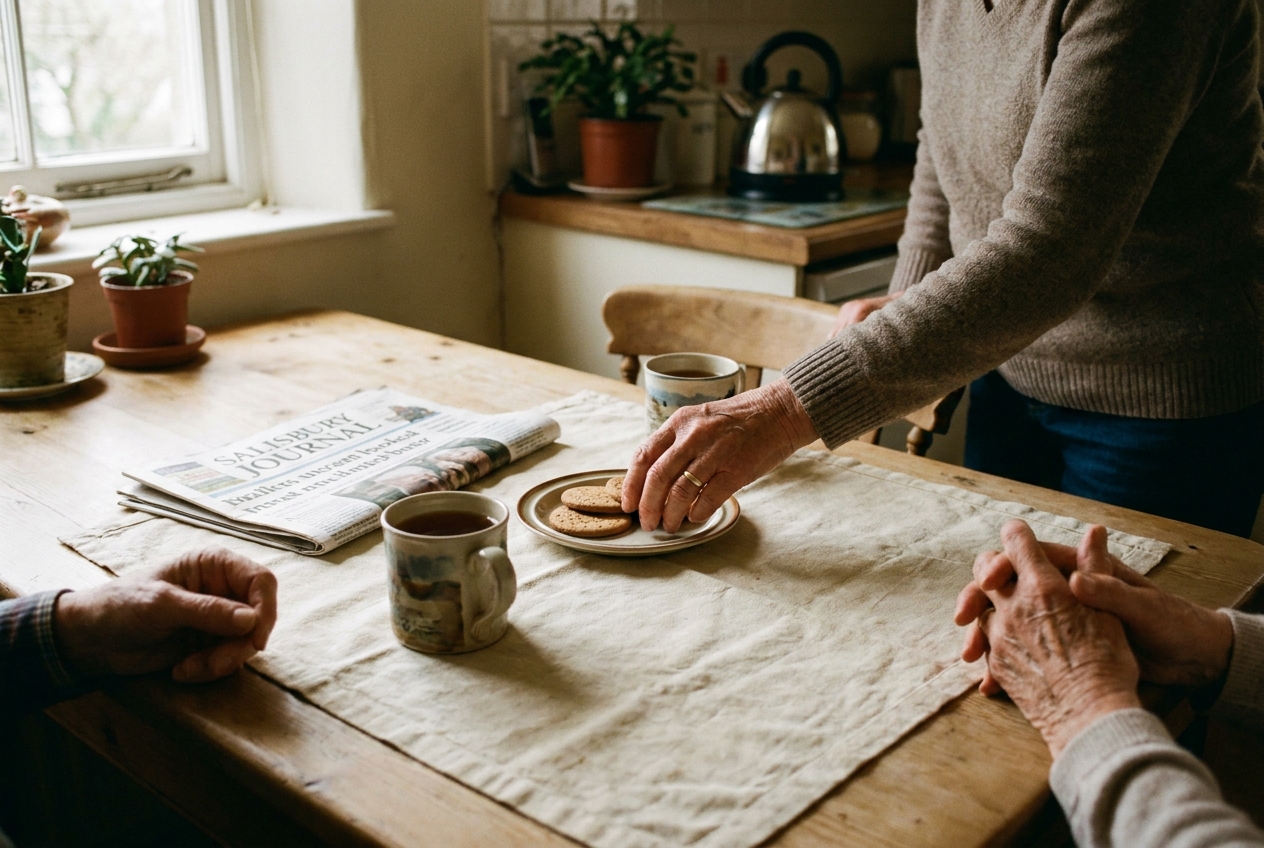
Helen joined Sunday Doors in 2022, after she retired from the John Lewis floor on Catherine Street and found, as she put it that Saturday, 'a kind of stillness that I wasn't ready for'. She was paired with Margaret, then seventy-five and living alone on Greencroft Street. Their first six visits, by Helen's own account, were 'mostly quiet, mostly tea, mostly the local paper, mostly Margaret doing me the kindness of not asking why I had come'.
That is how Sunday Doors works, and how it is meant to work. We train our befrienders for three months — six Saturday mornings, three to four hours each, run by our coordinator with input from Wiltshire Council adult social care. We talk about safeguarding, about boundaries, about the difference between visiting and rescuing. We give them a folder, a DBS check, a number to call if something goes wrong, and a deliberately quiet brief: turn up, on a Sunday afternoon, for an hour, and let what happens, happen.
A pairing is not a project
One of the most useful things our coordinator says, in the second weekend of training, is that a pairing is not a project. There is no outcome. There is no graduation. The befriender does not have a job to do; they have an hour to spend. This is harder than it sounds for new volunteers who arrive — as nearly all of ours do — from professional or pastoral backgrounds where their entire training has been about helping. We ask them, deliberately, to unlearn that.
In February's circle, six of the new cohort spoke about how strange that first month had felt. 'I sat there', said Anwen, a retired GP who had taken on her first pairing in November, 'and I thought, I am being useless. I am providing nothing. I am occupying a chair.' Halfway through her fourth visit, the woman she was visiting, in her eighty-second year, mentioned in passing that no-one had asked her about her late husband for sixteen months. They talked for forty minutes about a holiday in the Lleyn Peninsula in 1974. Anwen described it as the most useful she had felt in a decade.
'I had spent thirty-eight years asking the right diagnostic questions. The longest training I have done since I retired has been on how not to ask them.'
— Anwen, befriender since November 2025
What the training covers, and what it cannot
The six-Saturday curriculum was rewritten in 2023 after we received feedback from the second cohort that the original course had been too procedural. The current version covers, in this order: a history of the Charity (because Sunday Doors makes more sense if you know it sits inside a three-hundred-year tradition); the ethics of unsolicited presence in another person's home; the safeguarding obligations of a volunteer; the warning signs of decline, of self-neglect, of coercive control by family or others; how to listen without solving; what to do, exactly, if a visit goes wrong; and a long, deliberately unstructured Saturday morning of stories from longer-serving befrienders.
The last session — which we call simply 'Saturday Six' — is the one our new volunteers most often single out as the most valuable. There is no PowerPoint. There is a circle of chairs. We invite three or four befrienders who have been with us for at least three years to talk about what they have learned. The newcomers listen.
What none of the training covers is the smell of someone else's flat in winter. The slow, particular quality of the silence in a kitchen that hasn't had a visitor for several weeks. The way the kettle takes longer to boil than you remember. These are not things you can teach in a classroom. They are the substance of the work.
Numbers, for those who want them
The 2025–26 cohort took in eleven new befrienders, of whom nine remain with us today. Two stepped back during the training period, both for entirely reasonable personal reasons; we keep our door open to them. Of the nine, eight have now been visiting for at least four months. Six visit weekly; three visit fortnightly by mutual agreement with the person they visit.
Across all forty-two pairings — old and new — we recorded an average partnership length, last year, of three years and four months. Our longest current partnership is in its sixth winter. Our coordinator's working assumption, which is built into the training, is that we are recruiting volunteers for ten years of small Sunday afternoons, not for a single year of trial work. So far that assumption has held up.
The hardest number is the one that never appears in the annual return: the thirteen people on our 2026 waiting list, in St Martin's and St Edmund's parishes, who have been referred to us for befriending and whom we cannot pair until we recruit further. We will recruit two more befrienders in the September 2026 cohort. We may recruit three. We will not exceed forty-five active pairings, because our coordinator — at one part-time post — cannot supervise more, and we will not water down supervision.
A small, slow ambition
We have been asked, several times in the past three years, why we do not run Sunday Doors across the other Salisbury parishes — St Thomas's, St Paul's, and the suburbs beyond. The answer is the same as it was when we declined to extend our area of benefit in 2019: we do not have the trustee capacity, or the income, to do it well. The parishes we know, we know. Beyond them, we do not. There are good charities elsewhere in Salisbury — Alabaré, Age UK Wiltshire, the social prescribing team at Salisbury District Hospital — who do befriending well; we refer onward when we can.
What we can do is hold the work we have, year on year, well. Three months of training. Twelve months of tea. Three years and four months of slow Sunday afternoons. Those numbers, repeated across forty-two pairings, are the whole of the programme. They are not glamorous. They are the whole of the answer to the question of what John Fricker had in mind in 1696.
Written by the Trustees' Clerk for John Fricker's Charity of 1696. Names of newer befrienders are used with their written consent. Margaret has read and approved the section in which she appears.