
Field notes · · The Trustees' Clerk
'The eighty-pound difference.'
Between 14 November 2025 and 31 January 2026 we paid 142 First Frost fuel grants in the parishes of St Martin's and St Edmund's, Salisbury. This is what those payments did, what they didn't, and what we learned to do differently next winter.
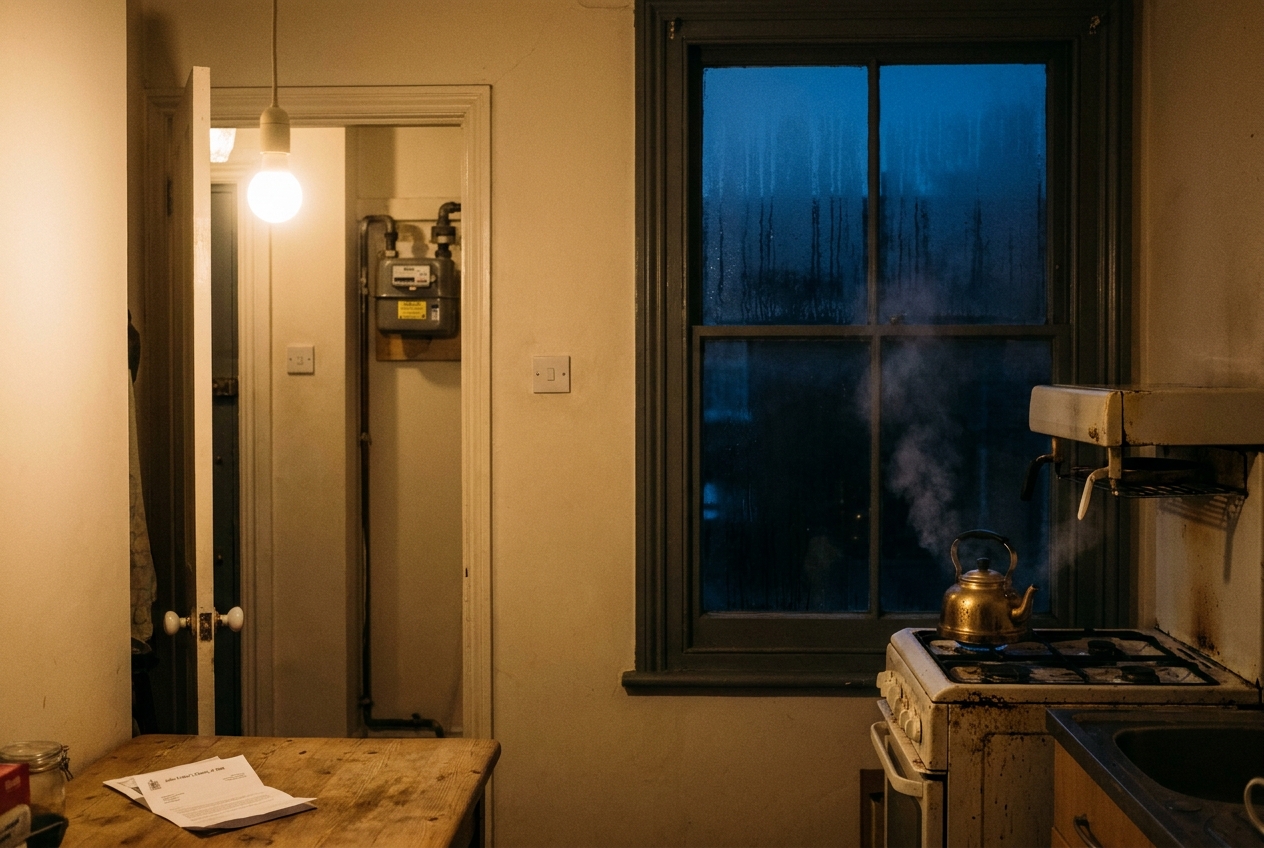
David lives in a one-bedroom flat above a shop on Milford Street. He is fifty-four, he was a chef at the Haunch of Venison until his second knee replacement in 2023, and his gas meter is a prepayment one — the kind where you walk down to the corner shop, pay over a card, and the heating works for a few more days. On the morning of 14 January 2026, he had ninety-six pounds in the bank, his rent was due on the eighteenth, and his meter wanted £180 to see him through the cold snap that had come in over Salisbury Plain the night before.
He had been referred to us by Salisbury Citizens Advice on the eleventh. His referral arrived with the Clerk on the morning of the twelfth. The trustees approved the case by email the same afternoon — under our standing procedure for cases of urgent fuel poverty between meetings — and a payment of eighty pounds was made by bank transfer to David's account on the morning of the thirteenth. His meter was topped up that afternoon. He kept the heat on. He paid the rent on the eighteenth.
Eighty pounds. That was the difference. We did not solve David's underlying situation; he is on Universal Credit, in arrears, on a waiting list for an Occupational Health assessment that will determine whether he is fit for a return to part-time kitchen work. We did not fix his flat, which is cold not because the heating is poor but because the building is older than the central-heating regulations. What we did was buy him three weeks. In three weeks the cold snap broke, the Citizens Advice caseworker filed his arrears review, and an interim payment came through. He has not needed us since.
A pattern, not a story
David's case is one of 142. We have written about him with his consent, because he asked us to (his words: 'tell people what it costs to keep a flat warm with the wrong meter and the wrong knees'). The other 141 cases follow a pattern that the trustees recognise from the previous five winters of the Fund.
The median grant we paid this winter was £140. The smallest was £80; the largest £240. We declined eight applications, of which seven came from households outside our area of benefit — all forwarded onward, with consent, to Wiltshire Community Foundation's cold weather pool. The eighth was a household within our area whose need, on the trustees' careful reading, was not fuel-specific; we made a £160 Quiet Quarter grant instead.
First Frost Fund · 2025–26 winter season
Grants made             142
Total paid              £19,596
Average grant           £138
Median grant            £140
Smallest grant          £80
Largest grant           £240
Applications declined   8 (7 outside area, 1 not fuel-specific)
Most common referrer    Salisbury Citizens Advice (51 referrals)
Second-most-common      St Martin's parish team (28 referrals)
Median time from
  referral to payment   6 working days
The number we are most quietly pleased with is the last: six working days, median, from the moment a referral landed on the Clerk's desk to the moment a payment cleared into the household's account. Last winter that figure was nine. The year before, twelve. The improvement is not a story about technology — we use no online portal, no claim software, nothing more sophisticated than a bound minute book and a shared spreadsheet — but about a rota. Two of our five trustees are now reachable, by phone or email, between meetings; cases are routed by the Clerk to whichever pair are on standing duty. We approve out of meeting only for fuel and food. We approve in person for everything else.
'Speed, in this work, is not a virtue in itself. But by the time it takes us nine working days to clear a fuel grant in January, somebody has already turned the heating off, and the work of asking us for help has started to feel pointless. Six is a different number.'
— Richard Allen, Chair, in his note to the February 2026 meeting
What we learned, that we will change for next winter
Three things, none of which are very dramatic.
First, our referral form is too long. It runs to six sections and asks two questions about household composition that we already know from the referring agency. The Clerk and the Chair will rewrite it before October 2026; we expect the new form to be one page, with no question we cannot read in under three minutes.
Second, we should pay by bank transfer faster. Eight of this winter's grants — about six per cent — were paid by cash through the Clerk because the household had no current account or the account had been frozen. Those payments took, on average, four days longer than transfers. We are exploring whether the Post Office's pre-loaded vouchers, used by some of our peer charities in Bristol and Bath, would shorten that lag without losing dignity. We have not decided.
Third — and this is the one we are most unsure about — our grant ceiling of £240 may be too low. Six households this winter needed more than that to bridge the cold snap, and we made up the difference in two cases through the Quiet Quarter Fund and in four cases by signposting onward. The trustees will review the ceiling at the September 2026 meeting; we will not change it without reading at least three years of historical data, and we will not let it run ahead of the income that funds the programme.
The honest paragraph
One hundred and forty-two grants is a small number against the size of the problem. Salisbury Foodbank ran 4,300 distributions to local households last winter. Wiltshire Council's cold weather payments reached more than nine thousand homes in the city alone. We are not a substitute for any of that. We are a small parish fund, paying small specific sums to small specific people who, for one reason or another, fell between the larger schemes. Eighty pounds is not much. It is the difference between a meter that runs out on a Tuesday afternoon and a meter that runs out on a Friday evening when the offices are shut. That is, more often than people realise, where the line is.
The Fund is open until 31 March 2026, whether or not the cold snap returns. After that we close it, count the leftover (this year there will be roughly £400), and ringfence it for the September 2026 reserve. If you would like to give to next winter, our 2025–26 Winter Fuel Appeal page stays open through April.
Written by the Trustees' Clerk for John Fricker's Charity of 1696. David's name and address details are used with his written consent.